Contents
Let us help you choose the ideal design: Vertical Vs Horizontal Rowing Tanks
When you buy through links on our website, we may earn a small commission at no cost to you. Thanks for your support 🙂
If you compare today’s rowing machine models with those from 10–15 years ago, you’ll notice big improvements. Manufacturers improved ergonomics, added digital screens that work with smartphones, and made many other changes in response to user feedback.
One recent design change focuses on rowing machine tanks. Older models used horizontal tanks, but many newer machines now use vertical or angled tanks. So why do some brands choose one tank orientation over another?
Rowing tank options
Rowing machines generally use one of three tank configurations:
-
Horizontal Tanks (traditional design): Many classic water rowers like the WaterRower Classic use this setup. Horizontal tanks spread water out flat, so the rowing motion feels very similar to on‑water rowing.
-
Angled Tanks: These sit at a 45° or 60° angle. They increase resistance and make workouts feel tougher.
-
Vertical Tanks: These sit upright at 90°. They’re less common but give you a more intense workout by increasing water resistance. You’ll find vertical tanks on models like the First Degree Fitness E520.
A horizontal rowing tank has been the classic design for rowing machines. The oldest rowing machine models on the market feature this configuration, but in newer models, the angle is adjusted due to recent innovations.
How Tank Orientation Affects Rowing Resistance
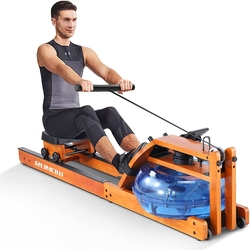 In a horizontal tank, water sits parallel to the ground.
This spreads resistance evenly throughout your stroke and feels smooth and natural, much like rowing a canoe or boat

Vertical tanks pull water up and down with each stroke. This changes how the water moves and increases resistance, so you need to work harder to complete each pull.
What’s the Main Difference Between Vertical and Horizontal Tanks?
The key difference lies in tank orientation. In horizontal tanks, water stays level with the floor. In vertical tanks, the water moves vertically as you row. This change affects how your stroke feels and how much effort you need to put in. Many rowers describe vertical tanks as feeling more challenging.
Best all-round strength training machine for 2026!

Gravity and Resistance
Gravity has a real impact on resistance. When water moves upward in a tank, you push against gravity as well as water resistance, which makes your workout harder. Angled tanks create more resistance than horizontal ones, and vertical tanks create the most of all.
| PRODUCT PREVIEW | NAME | REVIEWS | Check PRICE |
|---|---|---|---|
| RUNOW Water Rowing Machine | 332 Customer Ratings |
|
 | LIT Strength Machine |  |
|
  | SNODE Water Rowing Machine | 566 Customer Ratings |  |
 | ETONSUNNY Water Rower with Vertical Tank |
|
|
 | WaterRower Club Rowing Machine | 28 Customer Ratings | |
Do Vertical Tanks Save Space?
Yes – vertical tanks often make the overall rower shorter in length because the tank sits upright instead of stretching out in front of the rail. For example, a vertical tank rower can be noticeably shorter than comparable angled or horizontal models, even if they share similar height and width.
Check out our suggestions for the best rowing machines for smaller spaces here!
Tank Placement and Rowing Machine Size
Where manufacturers place the tank affects machine length and shape. Most rowing machines put the tank near the front of the machine.
With vertical tanks, designers often mount them on a separate stand closer to the pedals, which shortens the machine’s footprint. This placement also makes vertical rowers appear wider than some angled models.
Pros of a Horizontal Water Rowing Tank:
- Realistic rowing experience: A horizontal water rowing tank mimics the natural feel of rowing on water, providing a realistic rowing experience.
- Adjustable resistance: The resistance level can be adjusted by adding or removing water, allowing users to customize their workout intensity.
- Low-impact workout: Rowing is a low-impact exercise that is easy on the joints and reduces the risk of injury.
- Suitable for all fitness levels: Water rowing tanks are suitable for both beginners and experienced rowers, as the resistance can be adjusted to suit any fitness level.
Cons of a Horizontal Water Rowing Tank:
- Space requirements: A horizontal water rowing tank requires a lot of space, making it difficult to accommodate in smaller homes or apartments.
- High cost: Horizontal water rowing tanks are typically more expensive than other types of rowing machines, making them less accessible for some people.
- Maintenance: The tank requires regular maintenance, such as cleaning and changing the water, which can be time-consuming and costly.
- Limited resistance: While the resistance level can be adjusted, it may not be sufficient for more advanced rowers who require very high levels of resistance.
Pros of a Vertical Water Rowing Tank:
- Compact design: Vertical rowing tanks take up less floor space, making them ideal for smaller homes or apartments.
- Efficient storage: Many vertical designs can be stored upright, freeing up room when not in use.
- Effective cardio workout: Provides a strong cardiovascular workout similar to horizontal tanks, promoting endurance and fitness.
- Durable and sturdy: Often designed with a solid frame that can handle intense rowing sessions without wobbling.
Cons of a Vertical Water Rowing Tank:
- Less realistic rowing feel: The vertical orientation may not mimic the natural motion of rowing on water as closely as horizontal tanks.
- Limited stroke length: Vertical tanks may restrict the rowing stroke, which could reduce engagement of certain muscle groups.
- Resistance limitations: Adjustable resistance might be less smooth or less varied compared to horizontal water tanks.
- Learning curve: Some users may find the upright motion slightly less intuitive and require a period of adjustment.
The bottom line
Now that you understand how horizontal and vertical tanks differ, you can pick the design that suits your goals and space.
Many people get excellent workouts from traditional horizontal tanks. But if you want higher resistance or a more compact machine, vertical tanks may appeal to you.